Explanation
A turn
Everything Nawa does happens inside a turn: the stretch between your message and the answer that ends it. A turn is one visible thing in the transcript, however long it runs and however many tools and agents it uses; there is no separate "job" the work escapes into. This page explains what happens inside one.
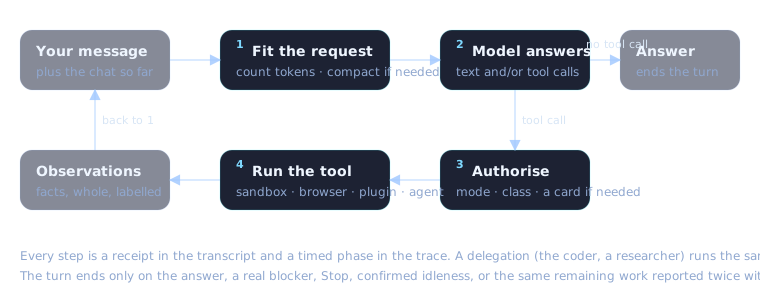
Before the first request
The engine reads the chat's history and the settings the renderer sent, resolves the active setup (the main model, and the coding and helper models when they differ), the classifier that screens external content, and the decision model if one is switched on. It loads the instruction files that apply — the profile's AGENTS.md, the project's, and any nested one already selected — and hands them over complete. It builds the tool list for this turn: Nawa's own tools, the workspace tools for the chat's permission mode, and the catalogue of plugins the model may load.
Then it fits the request: it materialises the exact request the provider will receive, counts its tokens, and compares the count with the model's window and the reserve it keeps for the answer. If the history is too long it compacts it — summarising the older part into a checkpoint while keeping the recent rounds and every unresolved observation verbatim — and counts again before sending. The count is token-based, never a character estimate, and where a provider offers an exact counting endpoint Nawa uses it.
The loop
- The model answers with text, tool calls, or both. Text streams to the transcript as it arrives.
- Each tool call is authorised against the turn's permission mode and the tool's security class (read, compute, workspace write, process, network, dispatch, external mutation). A call the mode does not allow pauses the turn with a permission card; your choice on the card is recorded in the trace with the time you took.
- The tool runs, and its result comes back as observations: a command's exit code, stdout and stderr; a page's elements; a file's content and version. A result too large for the model is stored whole as evidence and returned as a page the model can read further. External content — a web page, an email — is screened by the classifier before the model sees it and carries its provenance with it.
- Every result goes back to the model, and the request is fitted again. The loop continues until the model answers without a tool call.
Some tool calls are delegations: run_agent hands an objective to an agent with a context of its own — the coder, the web researcher — which runs the same loop with its own tools and reports back. A coder session that reaches its model's limit continues in a fresh session from a checkpoint of its own work, in the same turn and the same workspace; it is not moved to the background.
Ending
A turn ends when the model has answered and, for a turn that did work, when it has called the turn's terminal tool with its result — the harness demands that tool when an answer arrives without it, so a build cannot be reported as done by prose alone. It ends earlier on a genuine blocker, on your Stop generating, when the watchdog finds the work idle, or on genuine non-convergence: the exact same remaining work reported twice with the same authoritative progress. Elapsed time and turn counts are never the reason.
References in progress narration, final answers and automation results use the same publication checks. Local files must exist and be readable, citation identities must be available, and an application preview must have been published through the verified artifact path. An unavailable reference returns its exact failure to the model in the same turn; Nawa does not silently replace a broken link or remove an invalid preview. These checks establish resource availability, not whether every sentence about it is true. Interpreting results and writing accurate narration remain the model's responsibility.
If Nawa closes during a turn, the partial output is kept and the turn ends with a plain message saying it was interrupted.
What is kept
- The transcript: your message, the narration, every tool receipt, the answer — the memory of the chat.
- The trace: one record per phase (request preparation, model request, tool execution, screening, decisions, compaction) with timings and token counts, keyed by the trace id shown with any error, in
data\runtime\trace-index.jsonl. - The workspace: the chat's files, with per-dispatch commits as the undo mechanism.
- Memory, when it is on: durable facts about you, kept in one store the model maintains with your approval.
Why it is shaped this way
- One visible work model, because a build that disappears into a background path is a build the user cannot see or stop.
- Fitting before every request, because a request the provider truncates silently is worse than one that is compacted openly; the compaction is itself an event in the transcript.
- Observations rather than verdicts in tool results, because an exit code is data (
rgexits 1 for "no matches") and the model, not the harness, decides what it means. - Convergence by authoritative progress rather than by clocks, because productive work has no stopwatch and stalled work has no excuse.
The notes docs/compaction-unification-2026-09-14.md, docs/context-accounting-2026-09-14.md and docs/continuation-and-controls-2026-09-15.md in the source tree record the measurements behind these rules.